
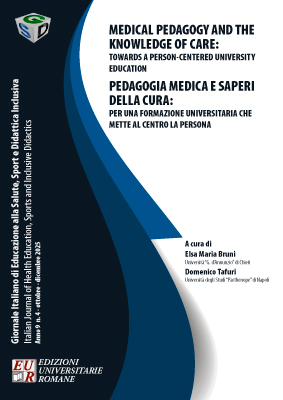
SOFT SKILLS AND MEDICAL EDUCATION: THE CENTRALITY OF THE PERSON BETWEEN UNIVERSITY CURRICULUM REFORM AND PEDAGOGICAL PERSPECTIVES
DOI:
https://doi.org/10.32043/gsd.v9i4.1640Keywords:
Medical Education, Soft Skills, PedagogyAbstract
The article examines the Bernini Reform (2025) and its impact on medical education, which reintroduces pedagogical courses in Medicine to foster soft skills such as empathy, communication, and interpersonal abilities. Inspired by Engel’s bio-psycho-social model, it highlights the role of pedagogical sciences in shaping a holistic medical professionalism. The case of Parthenope University illustrates a person-centered training model grounded in the pedagogy of care.
References
Borrell-Carrió, F., Suchman, A. L., & Epstein, R. M. (2004). The biopsychosocial model 25 years later: principles, practice, and scientific inquiry. Annals of Family Medicine, 2(6), 576–582.
Bruni, E. M. (2008). Pedagogia e cura: Percorsi di formazione e responsabilità educativa. Roma: Carocci.
Bruni, E. M. (2015). Pedagogia della cura: Dalla relazione educativa alla responsabilità professionale. Napoli: Liguori.
Bruni, E. M. (2017). La formazione come cura: Linee di pedagogia umanistica. Milano: FrancoAngeli.
Bruni, E. M. (2024). Educare alla cura: Prospettive pedagogiche nella formazione dei professionisti della salute. Bologna: Il Mulino.
Bruni, E. M. (2025). Università e formazione integrale: Pedagogia, ricerca e Terza Missione. Napoli: Editoriale Scientifica.
Cambi, F. (2000). Le pedagogie del Novecento. Laterza.
Cambi, F. (2006). Le pedagogie del Novecento. Roma-Bari: Laterza.
Cambi, F. (2010). La cura di sé come processo formativo. Laterza.
Decety, J., & Jackson, P. L. (2004). The functional architecture of human empathy. Behavioral and Cognitive Neuroscience Reviews, 3(2), 71–100.
Engel, G. L. (1977). The need for a new medical model: a challenge for biomedicine. Science, 196(4286), 129–136.
Frenk, J., et al. (2010). Health professionals for a new century: transforming education to strengthen health systems. The Lancet, 376(9756), 1923–1958.
Issenberg, S. B., et al. (2005). Features and uses of high-fidelity medical simulations that lead to effective learning: a BEME systematic review. Medical Teacher, 27(1), 10–28.
Kurtz, S., Silverman, J., & Draper, J. (2016). Teaching and Learning Communication Skills in Medicine. CRC Press.
Mortari, L. (2002). La pratica dell’aver cura. Bruno Mondadori.
Mortari, L. (2015). Filosofia della cura. Raffaello Cortina.
Noddings, N. (1984). Caring: A feminine approach to ethics and moral education. Berkeley: University of California Press.
Rider, E. A., & Keefer, C. H. (2006). Communication skills competencies: definitions and a teaching toolbox. Medical Education, 40(7), 624–629.
Schön, D. (1983). The Reflective Practitioner. Basic Books.
Ten Cate, O., & Scheele, F. (2007). Competency-based postgraduate training: bridging theory and practice. Academic Medicine, 82(6), 542–547.
van der Vleuten, C. P. M., et al. (2015). Twelve tips for programmatic assessment. Medical Teacher, 37(7), 641–646.
Tartwijk, J. (2015). A model for programmatic assessment fit for purpose. Medical Teacher, 37(7), 738–746. https://doi.org/10.3109/0142159X.2015.1009026
Downloads
Published
Issue
Section
License
Copyright (c) 2026 Domenico Tafuri

This work is licensed under a Creative Commons Attribution 4.0 International License.
The licence that applies to this article is the one shown above and on its first page. Since Volume 7 (2023) the journal publishes under the Creative Commons Attribution 4.0 International License (CC BY 4.0); articles in Volumes 1–6 (2017–2022) were published under the Creative Commons Attribution–NonCommercial–NoDerivatives 3.0 Italy License (CC BY-NC-ND 3.0 IT) and keep that licence. Authors retain copyright of their work and grant the journal the right of first publication.
