
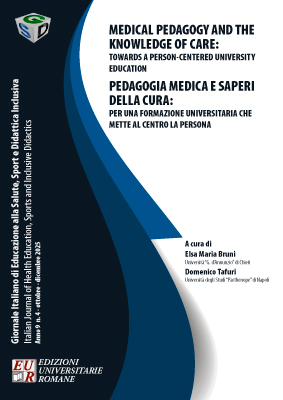
RE-EMBODYING MEDICAL EDUCATION FOR HUMANISED CARE: BETWEEN TECHNOLOGY, INCLUSION AND NARRATIVE EXPERIENCE
DOI:
https://doi.org/10.32043/gsd.v9i4.1654Keywords:
Body pedagocics, narrative medicine, care relationship, inclusivity, technology.Abstract
The article reflects on the challenges currently shaping the education of health professionals in light of recent technological and social transformations, characterised by the development of artificial intelligence and increasing systemic complexity. Drawing on the theoretical frameworks of body pedagogics and embodied cognition, it highlights the need to restore centrality to the subjective corporeal dimension in both professional education and the care relationship, in order to promote an experience of care genuinely oriented toward the person.
References
Benini, S. (2002). Attimi di raggiungibilità: l’occasione di un incontro, in Balduzzi L. (a cura di), Voci del corpo. Prospettive pedagogiche e didattiche (pp. 261-272). Milano: La Nuova Italia.
Bleakley, A. (2020). Educating Doctors' Senses Through the Medical Humanities: "How Do I Look?". Abingdon (Oxon): Routledge.
Bouamra, B., Chakroun, K., Medeiros De Bustos, E., Dobson, J., Rouge, J.-A., & Moulin, T. (2021). Simulation-Based Teaching of Telemedicine for Future Users of Teleconsultation and Tele-Expertise: Feasibility Study. JMIR Medical Education, 7(4), e30440. https://doi.org/10.2196/30440
Brottman, M. R., Char, D. M., Hattori, R. A., Heeb, R., & Taff, S. D. (2020). Toward Cultural Competency in Health Care: A Scoping Review of the Diversity and Inclusion Education Literature. Academic medicine: journal of the Association of American Medical Colleges, 95(5), 803-813. https://doi.org/10.1097/ACM.0000000000002995.
Bruni, E.M. (2008). Pedagogia e trasformazione della persona. Lecce: Pensa MultiMedia.
Cambi, F. (2010). Corpo multiplo e formazione postmoderna: una frontiera della “cura sui”. In Cunti, A. (a cura di), La rivincita dei corpi. Movimento e sport nell’agire educativo (pp. 21-27). Milano: FrancoAngeli.
Ceruti, M. (2018). Il tempo della complessità. Milano: Raffaello Cortina Editore.
Charon, R. (2006). Narrative Medicine: Honoring the Stories of Illness. New York, NY: Oxford University Press.
Crenshaw, K. (1989). Demarginalizing the Intersection of Race and Sex: A Black Feminist Critique of Antidiscrimination Doctrine, Feminist Theory and Antiracist Politics. University of Chicago Legal Forum, 1989(1), 139-167.
Curtis, E., Jones, R., Tipene-Leach, D., Walker, C., Loring, B., Paine, S. J., & Reid, P. (2019). Why cultural safety rather than cultural competency is required to achieve health equity: a literature review and recommended definition. International journal for equity in health, 18(1), 174. https://doi.org/10.1186/s12939-019-1082-3.
Eichenberg, T. B., Parikh, S., Cox, J., Doshi, D., Padilla-Register, M., & DallaPiazza, M. (2023). An Educational Session for Medical Students Exploring Weight Bias in Clinical Care Through the Lens of Body Diversity. MedEdPORTAL: the journal of teaching and learning resources, 19, 11342. https://doi.org/10.15766/mep_2374-8265.11342
Elendu, C., Amaechi, D. C., Okatta, A. U., Amaechi, E. C., Elendu, T. C., Ezeh, C. P., & Elendu, I. D. (2024). The impact of simulation-based training in medical education: A review. Medicine, 103(27), e38813. https://doi.org/10.1097/MD.0000000000038813
Frenk, J., Chen, L., Bhutta, Z. A., Cohen, J., Crisp, N., Evans, T., Fineberg, H., Garcia, P., Ke, Y., Kelley, P., Kistnasamy, B., Meleis, A., Naylor, D., Pablos-Mendez, A., Reddy, S., Scrimshaw, S., Sepulveda, J., Serwadda, D., & Zurayk, H. (2010). Health professionals for a new century: Transforming education to strengthen health systems in an interdependent world. The Lancet, 376(9756), 1923-1958.
Frenk, J., Chen, L. C., Chandran, L., Groff, E. O., King, R., Meleis, A., & Fineberg, H. V. (2022). Challenges and opportunities for educating health professionals after the COVID-19 pandemic. The Lancet, 400(10362), 1539-1556.
Kelly, M., Ellaway, R., Scherpbier, A., King, N., & Dornan, T. (2019). Body pedagogics: embodied learning for the health professions. Medical education, 53(10), 967-977.
Quinn, T. P., & Coghlan, S. (2021). Readying medical students for medical AI: The need to embed AI ethics education. arXiv:2109.02866.
Randhawa, G. K., & Jackson, M. (2020). The role of artificial intelligence in learning and professional development for healthcare professionals. Healthcare management forum, 33(1), 19–24. https://doi.org/10.1177/0840470419869032
Shaw, K., Henning, M. A., & Webster, C. S. (2025). Artificial Intelligence in Medical Education: a Scoping Review of the Evidence for Efficacy and Future Directions. Medical science educator, 35(3), 1803-1816. https://doi.org/10.1007/s40670-025-02373-0.
Verdonk, P., & Janczukowicz, J. (2018). Editorial: Diversity in medical education. MedEdPublish, 7(1), 1-4. https://doi.org/10.15694/mep.2018.000001.1
Wong, B. L. H., Gishen, F., & Lokugamage, A. U. (2021). “Decolonising” the medical curriculum: Humanising medicine through epistemic pluralism, cultural safety and critical consciousness. London Review of Education, 19(1), 1-13. https://doi.org/10.14324/LRE.19.1.05
WHO. World Health Organization (2021). Ethics and Governance of Artificial Intelligence for Health: WHO Guidance. Geneva: World Health Organization. Ethics and governance of artificial intelligence for health
WHO. World Health Organization (2024). Ethics and governance of large multimodal models for health. Guidance on large multi-modal models. Geneva: World Health Organization. Ethics and governance of artificial intelligence for health: Guidance on large multi-modal models
Zannini, L. (2008). Medical Humanities e medicina narrativa. Nuove prospettive per i professionisti della cura. Milano: Raffaello Cortina Editore.
Zedda, M. (2016). Identità corporea e pratica autobiografica. In Cunti, A. (a cura di), Sfide dei corpi. Identità, corporeità, educazione (pp. 82-92). Milano: FrancoAngeli
Downloads
Published
Issue
Section
License
Copyright (c) 2026 Martina Petrini

This work is licensed under a Creative Commons Attribution 4.0 International License.
The licence that applies to this article is the one shown above and on its first page. Since Volume 7 (2023) the journal publishes under the Creative Commons Attribution 4.0 International License (CC BY 4.0); articles in Volumes 1–6 (2017–2022) were published under the Creative Commons Attribution–NonCommercial–NoDerivatives 3.0 Italy License (CC BY-NC-ND 3.0 IT) and keep that licence. Authors retain copyright of their work and grant the journal the right of first publication.
