
Editoriale
DOI:
https://doi.org/10.32043/gsd.v9i4.1677Abstract
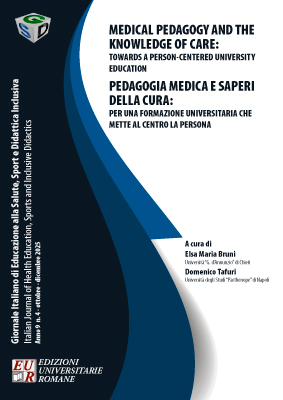
In recent years, university education in the medical-health field has undergone profound rethinking: technical-scientific competence alone is no longer sufficient, and it is necessary to integrate pedagogical and humanistic knowledge to build a professionalism centered on the person and the quality of care. Medical Pedagogy thus emerges as a key field for combining clinical skills with relational, ethical, communicative, and narrative dimensions, in line with the biopsychosocial model and Narrative Medicine.
Care is therefore understood as a formative process requiring listening, empathy, responsibility, and professional reflexivity. This perspective implies a revision of university curricula from an interdisciplinary standpoint and the structural inclusion of communication skills, also supported by innovative methodologies such as simulation. Recent models of competency-based education and formative assessment further reinforce this approach, consistent with current health policies aimed at personalization and proximity in care.
The journal therefore invites theoretical, empirical, and applied contributions on the role of pedagogy and the medical humanities in university education in the medical-health field.
Downloads
Published
Issue
Section
License
Copyright (c) 2026 Elsa Maria Bruni, Domenico Tafuri

This work is licensed under a Creative Commons Attribution 4.0 International License.
The licence that applies to this article is the one shown above and on its first page. Since Volume 7 (2023) the journal publishes under the Creative Commons Attribution 4.0 International License (CC BY 4.0); articles in Volumes 1–6 (2017–2022) were published under the Creative Commons Attribution–NonCommercial–NoDerivatives 3.0 Italy License (CC BY-NC-ND 3.0 IT) and keep that licence. Authors retain copyright of their work and grant the journal the right of first publication.
