
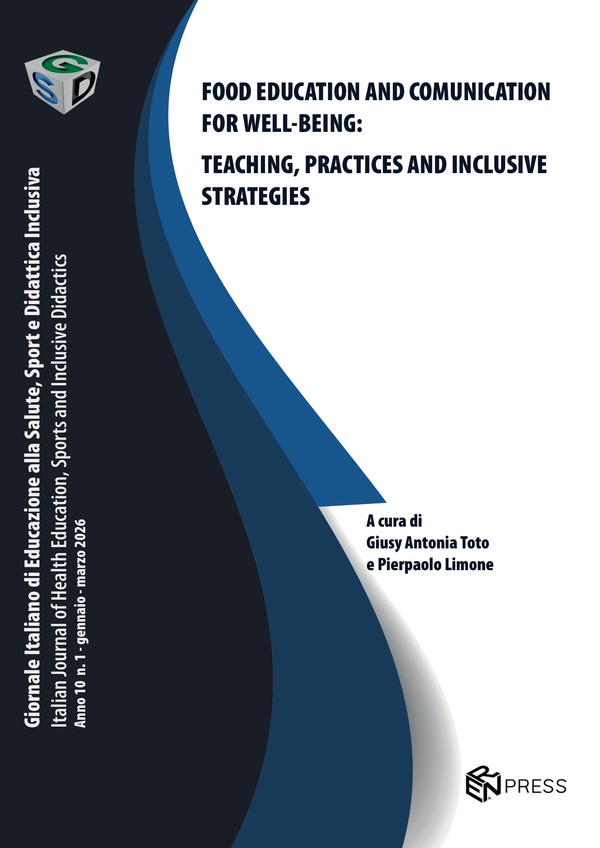
NUTRITIONAL EDUCATION TO ENSURE THE ATHLETE'S PHYSICAL AND MENTAL WELL-BEING
DOI:
https://doi.org/10.32043/gsd.v1i1.1696Keywords:
Food education, Psychophysical well-being, Food literacyAbstract
The modern food system exposes adolescents and young adults to complex consumption patterns, often characterised by the prevalence of ultra-processed foods, the pressure of digital marketing, and the circulation of nutritional information that is not always scientifically sound. In this context, student-athletes represent a particularly vulnerable group, as their dietary choices are influenced both by the demands of sporting performance and by psychological, social, and cultural factors. Nutrition education, understood as a process of developing food literacy, can therefore contribute not only to improving nutritional knowledge but also to promoting physical and mental well-being.
This mixed-methods experimental study aimed to evaluate the effectiveness of an educational intervention targeting student-athletes aged between 16 and 20. The sample consisted of 60 participants, randomly divided into an experimental group (n = 30) and a control group (n = 30). The experimental group took part in an eight-week nutrition education programme, based on theoretical, practical and reflective activities; the control group continued with their normal school and sporting activities. Quantitative data were collected using the Nutrition for Sport Knowledge Questionnaire (NSKQ), administered before and after the intervention. Qualitative data were collected through semi-structured interviews conducted with 15 students in the experimental group.
The quantitative results showed a significant increase in nutritional knowledge within the experimental group, which rose from an average score of 48.6 ± 7.9 in the pre-test to 76.4 ± 6.8 in the post-test (p < 0.001). The control group showed minimal and non-significant changes. The qualitative interviews confirmed these results, revealing greater dietary awareness, a better understanding of the relationship between diet, energy, concentration and recovery, and a more critical attitude towards supplements, social media and food marketing.
Downloads
Published
Issue
Section
License
Copyright (c) 2026 Gianluca Gravino, Emma Saraiello

This work is licensed under a Creative Commons Attribution 4.0 International License.
The licence that applies to this article is the one shown above and on its first page. Since Volume 7 (2023) the journal publishes under the Creative Commons Attribution 4.0 International License (CC BY 4.0); articles in Volumes 1–6 (2017–2022) were published under the Creative Commons Attribution–NonCommercial–NoDerivatives 3.0 Italy License (CC BY-NC-ND 3.0 IT) and keep that licence. Authors retain copyright of their work and grant the journal the right of first publication.
