
THE IMPACT OF DIGITAL TECHNOLOGIES ON YOUTH SPORTS DROPOUT: CHALLENGES AND OPPORTUNITIES FOR EDUCATIONAL ENVIRONMENTS
DOI:
https://doi.org/10.32043/gsd.v9i1.1393Abstract
This review explores how digital technologies affect youth sport dropout. While AI, virtual platforms, and apps can enhance motivation and training, they may also cause distraction, sedentariness, and low self-esteem. By analyzing current literature, the study suggests how educational settings can use technology to reduce dropout and promote long-term engagement in sports.
Riferimenti bibliografici
Alexandris, K., Tsorbatzoudis, C., & Grouios, G. (2002). Perceived constraints on recreational sport participation: Investigating their relationship with intrinsic motivation, extrinsic motivation and amotivation. Journal of Leisure Research, 34(3), 233–252.
Bailey, R. (2006). Physical education and sport in schools: A review of benefits and outcomes. Journal of School Health, 76(8), 397–401.
Balish, S. M., Rainham, D., Blanchard, C., & Côté, J. (2014). Correlates of youth sport attrition: A review and future directions. Psychology of Sport and Exercise, 15(4), 429–439.
Borrione, P., Grassi, A., Palmer, K., & Lazzarino, A. I. (2021). Wearable technology in children and adolescents: A narrative review. Frontiers in Public Health, 9, 674336. https://doi.org/10.3389/fpubh.2021.674336
Crawford, D. W., & Godbey, G. (1987). Reconceptualizing barriers to family leisure. Leisure Sciences, 9(2), 119–127.
Crawford, D. W., Jackson, E. L., & Godbey, G. (1991). A hierarchical model of leisure constraints. Leisure Sciences, 13(4), 309–320.
Crane, J., & Temple, V. (2015). A systematic review of dropout from organized sport among children and youth. European Physical Education Review, 21(1), 114–131.
Dunton, G. F., Do, B., & Wang, S. D. (2020). Early effects of the COVID-19 pandemic on physical activity and sedentary behavior in children living in the U.S. BMC Public Health, 20, 1351. https://doi.org/10.1186/s12889-020-09429-3
Eime, R. M., Young, J. A., Harvey, J. T., Charity, M. J., & Payne, W. R. (2013). A systematic review of the psychological and social benefits of participation in sport for children and adolescents. International Journal of Behavioral Nutrition and Physical Activity, 10, 98.
Guthold, R., Stevens, G. A., Riley, L. M., & Bull, F. C. (2020). Global trends in insufficient physical activity among adolescents: A pooled analysis of 298 population-based surveys with 1.6 million participants. The Lancet Child & Adolescent Health, 4(1), 23–35.
Kirk, D. (2010). Physical education futures. Routledge.
Light, R., & Harvey, S. (2019). Pedagogical cases in physical education and youth sport. Routledge.
Livingstone, S., & Third, A. (2017). Children and young people's rights in the digital age: An emerging agenda. New Media & Society, 19(5), 657–670.
Moore, S. A., Faulkner, G., Rhodes, R. E., et al. (2020). Impact of the COVID-19 virus outbreak on movement and play behaviours of Canadian children and youth: A national survey. International Journal of Behavioral Nutrition and Physical Activity, 17(1), 85. https://doi.org/10.1186/s12966-020-00987-8
Nesi, J., & Prinstein, M. J. (2015). Using social media for social comparison and feedback-seeking: Gender and popularity moderate associations with depressive symptoms. Journal of Abnormal Child Psychology, 43, 1427–1438.
Pisaniello, A., Figus, A., Digennaro, S., & Spulber, D. (2024). Determining factors of sports dropout of young scholars: A cross-sectional analysis in the 8–13-year age group. Frontiers in Sports and Active Living, 6, Article 1330346. https://doi.org/10.3389/fspor.2024.1330346
Rathbone, A., Freeman, P., O'Donnell, S., & Swann, C. (2022). The impact of screen time on youth sport participation: A review through the lens of leisure constraints theory. Journal of Leisure Research, 54(1), 63–82.
Rideout, V., Peebles, A., Mann, S., & Robb, M. B. (2021). Common Sense Census: Media use by tweens and teens, 2021. Common Sense Media.
Ryan, R. M., & Deci, E. L. (2000). Self-determination theory and the facilitation of intrinsic motivation, social development, and well-being. American Psychologist, 55(1), 68–78.
Spulber, D., Pisaniello, A., & Digennaro, S. (2024). Analyzing gender dynamics: A comprehensive investigation into sports dropout phenomena. Global Sport Development, 8(2). https://doi.org/10.32043/gsd.v8i2.1182
Staiano, A. E., & Calvert, S. L. (2011). Exergames for physical education courses: Physical, social, and cognitive benefits. Child Development Perspectives, 5(2), 93–98.
Staiano, A. E., Beyl, R. A., Hsia, D. S., Katzmarzyk, P. T., & Newton, R. L. (2020). Twelve weeks of dance exergaming in overweight and obese adolescent girls: Transfer effects on physical activity, screen time, and self-efficacy. Journal of Sport and Health Science, 9(3), 212–219.
Tan, T. C., Bocarro, J., & Smith, J. (2021). Virtual coaching and online sport participation during COVID-19: Exploring technology’s potential for resilience. International Journal of Sport Policy and Politics, 13(3), 455–471.
Twenge, J. M., & Campbell, W. K. (2018). Associations between screen time and lower psychological well-being among children and adolescents: Evidence from a population-based study. Preventive Medicine Reports, 12, 271–283.
Twenge, J. M., Martin, G. N., & Spitzberg, B. H. (2018). Trends in U.S. adolescents’ media use, 1976–2016: The rise of digital media, the decline of TV, and the (near) demise of print. Psychology of Popular Media Culture, 8(4), 329–345.
Von Elm, E., Altman, D. G., Egger, M., et al. (2007). The Strengthening the Reporting of Observational Studies in Epidemiology (STROBE) statement: Guidelines for reporting observational studies. International Journal of Surgery, 12(12), 1495–1499.
Weiss, M. R., & Williams, L. (2004). The why of youth sport involvement: A developmental perspective on motivational processes. In M. R. Weiss (Ed.), Developmental sport and exercise psychology: A lifespan perspective (pp. 223–268). Fitness Information Technology.
World Health Organization. (2020). Guidelines on physical activity and sedentary behaviour. https://www.who.int/publications/i/item/9789240015128
Dowloads
Pubblicato
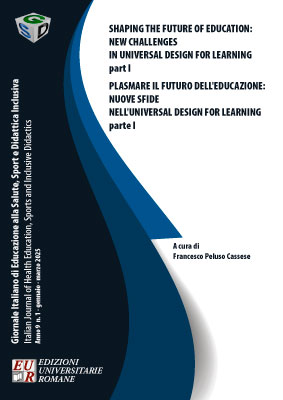
Fascicolo
Sezione
Licenza
Copyright (c) 2025 Andrea Pisaniello, Alessandro Figus, Diana Spulber

Questo volume è pubblicato con la licenza Creative Commons Attribuzione 4.0 Internazionale.
La licenza che si applica a questo articolo è quella indicata sopra e nella sua prima pagina. Dal Volume 7 (2023) la rivista pubblica con licenza Creative Commons Attribuzione 4.0 Internazionale (CC BY 4.0); gli articoli dei Volumi 1–6 (2017–2022) sono stati pubblicati con licenza Creative Commons Attribuzione – Non commerciale – Non opere derivate 3.0 Italia (CC BY-NC-ND 3.0 IT) e mantengono quella licenza. Gli autori mantengono i diritti sulla propria opera e concedono alla rivista il diritto di prima pubblicazione.
