
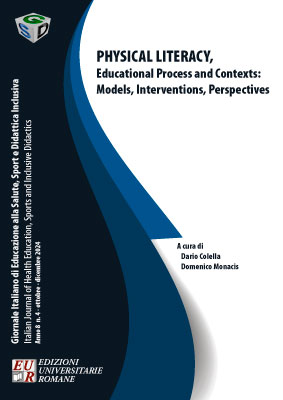
PHYSICAL LITERACY: A NEW LEARNING DIRECTION FOR INDIVIDUAL DEVELOPMENT IN SOCIETY
DOI:
https://doi.org/10.32043/gsd.v8i4.1241Abstract
Physical Literacy (PL) has gained increasing importance as it is not limited to the mere learning of physical skills in physical education, but extends to a holistic approach involving emotional, cognitive and social aspects.
The aim of this article is to explore the theoretical models that support PL, to analyse the educational interventions that foster its development and to discuss future perspectives for its integration into social and school contexts.
Riferimenti bibliografici
Barberini, G., Dotto, A., Bortoli, L., e Robazza, C. (1996). Self-efficacy, ansia ed emozioni nello sport giovanile. Movimento, 12, 54-56.
Borgogni, A., & Farinella, R. (2017), Le città attive. Milano: Franco Angeli
Bortoli, L., Robazza, C. (1993). Le aspettative personali di efficacia nell’apprendimento motorio e nella prestazione. Didattica del movimento, 86/87, 48-56.
Calcerano, L., & Casolo, F. (2003). Educazione Motoria e Sportiva, Brescia: La Scuola.
Colella, D., Bellantonio, S., D'Arando, C., & Monacis, D. (2020). Interventions for the promotion of motor activities in primary school. Assessment of motor performance in relation to perceived self-efficacy and enjoyment. ITALIAN JOURNAL OF EDUCATIONAL RESEARCH, (25), 49–62. https://doi.org/10.7346/SIRD-022020-P49
Dinham, J. & Williams, P. (2019). Developing Children’s Physical Literacy: How well prepared are prospective teachers?.
Durden-Myers, E. & Whitehead, M. (2018). Operationalizing Physical Literacy: Special Issue Editorial.
Durden-Myers, E., R. Green, N., & E. Whitehead, M. (2018). Implications for Promoting Physical Literacy.
DurdenMyers, E., Whitehead M.E., & Pot, N. (2018). Physical Literacy and Human Flourishing. Journal of Teaching in Physical Education, 37 (3). pp. 308311. https://doi.org/10.1123/jtpe.2018-0132
Frostig, M. (1970). Movement education: Theory and practice, Chicago: Follet education Corp, pp.9, 10.
Gardner, H. (1993), Educazione e sviluppo della mente. Intelligenze multiple e apprendimento, trad. it., Erickson, Trento 2005.
Greco, G. (2004). L’avvento della società mediale. Riflessioni su politica, sport, educazione. Milano, Franco Angeli.
Hernaiz-Sánchez, A., Villaverde-Caramés, E. J., González-Valeiro, M., & Fernández-Villarino, M. A. (2021). Physical literacy and teacher training: Pilot study. Education Sciences, 11(2), 42.
Huizinga, J. (1946). 20022. Homo ludens.
Margiotta, U. (2017). Editoriale: Generative Education: vent’anni dopo il Rapporto Delors. Formazione & Insegnamento, 15(2), 11–16. https://ojs.pensamultimedia.it/index.php/siref/article/view/2333
Merni F., Aversa C., Brugnara S., Ceciliani A. (2012). Reliability and validity of dexterity circuits in the "Alfabetizzazione Motoria" project.
Ministero dell’Istruzione dell’Università e della Ricerca, (2012), Indicazioni Nazionali del Curricolo per la Scuola dell’Infanzia. https://www.mim.gov.it/documents/20182/51310/DM+254_2012.pdf
OECD (2017). PISA 2015 Results (Volume III): Students’ Well-Being, PISA, OECD Publishing, Paris. http://dx.doi.org/10.1787/9789264273856-en.
Pascali, G., & Monacis, D. (2024). Metodi di Valutazione della Physical Literacy nella scuola primaria. Review della letteratura. IUL Research, 5(9), 311-330.
Robazza, C., & Ruiz, M. C. (2019). Emotion and performance. D. Hackfort, R. J. Schinke, & B. Strauss (Eds.). Dictionary of sport psychology: Sport, exercise, and performing arts (p. 93). London, UK: Academic Press.
Roetert, E. P., Kriellaars, D., Ellenbecker, T. S., & Richardson, C. (2017). Preparing students for a physically literate life. Journal of Physical Education, Recreation & Dance, 88(1), 57-62.
Shearer, C., R. Goss, H., Cerys Edwards, L., J. Keegan, R., R. Knowles, Z., M. Boddy, L., J. Durden-Myers, E., & Foweather, L. (2018). How Is Physical Literacy Defined? A Contemporary Update.
Save the Children (2021). “Il valore formativo dello sport: perché è importante fin dall’infanzia”. https://www.savethechildren.it/blog-notizie/valore-formativo-dello-sport-perche-e-importante-dall-infanzia
SISMeS (2024). L’educazione fisica in italia: scenari, sfide, prospettive. Documento di consenso del Gruppo di Studio “Educazione Fisica & Pedagogia dello Sport” della SISMeS (Società Italiana delle Scienze Motorie e Sportive)
Unesco, Education 2030 Framework for Action. https://uis.unesco.org/sites/default/files/documents/education-2030-incheon-framework-for-action-implementation-of-sdg4-2016-en_2.pdf
Whitehead, M.E. (2013). The history and development of physical literacy. Bulletin 65, Journal of Sport Science and Physical Education, International Council of Sport Science and Physical Education (ICSSPE), 65, 22-28.
Whitehead, M.E. (Ed.). (2010). Physical literacy: Throughout the lifecourse. London, UK: Routledge.
Whitehead, M.E.(2013). Definition of physical literacy and clarification of related. Bulletin No 65, Journal of Sport Science and Physical Education, International Council of Sport Science and Physical Education (ICSSPE), 65, 29-34.
Dowloads
Pubblicato
Fascicolo
Sezione
Licenza
Copyright (c) 2025 Guido Scarano, Maria Giovanna Tafuri, Gerarda Borriello

Questo volume è pubblicato con la licenza Creative Commons Attribuzione 4.0 Internazionale.
La licenza che si applica a questo articolo è quella indicata sopra e nella sua prima pagina. Dal Volume 7 (2023) la rivista pubblica con licenza Creative Commons Attribuzione 4.0 Internazionale (CC BY 4.0); gli articoli dei Volumi 1–6 (2017–2022) sono stati pubblicati con licenza Creative Commons Attribuzione – Non commerciale – Non opere derivate 3.0 Italia (CC BY-NC-ND 3.0 IT) e mantengono quella licenza. Gli autori mantengono i diritti sulla propria opera e concedono alla rivista il diritto di prima pubblicazione.
