
CREATIVITY, MOVEMENT AND UNIVERSAL DESIGN FOR LEARNING: PERSPECTIVES FOR INCLUSIVE TEACHING IN TEACHER
DOI:
https://doi.org/10.32043/gsd.v9i1.1347Parole chiave:
Creativity, Universal Design for Learning, educational innovation, teacher training, inclusive learningAbstract
Amid the increasing complexity of educational environments, contemporary pedagogy advocates for a culture of diversity, inclusion, and active participation, emphasizing creativity and movement as pivotal drivers for the holistic development of learners. Within this paradigm, Universal Design for Learning (UDL) emerges as a forward-thinking framework. A study conducted at Kore University investigates the implementation of UDL principles in teacher education and explores the new educational challenges that accompany this evolving approach.
Riferimenti bibliografici
Al-Azawei, A., Serenelli, F., & Lundqvist, K. (2016). Universal design for learning (UDL): A content analysis of peer-reviewed journal papers from 2012 to 2015. Journal of the Scholarship of Teaching and Learning, 16(3), 39–56. https://doi.org/10.14434/josotl.v16i3.19295
Bandura, A. (1977). Self-efficacy: Toward a unifying theory of behavioral change. Psychological Review, 84(2), 191–215. https://doi.org/10.1037/0033-295X.84.2.191
Bertagna, G. (2001). Pedagogia e sport. La Scuola.
Bowman, L. L., Frame, M. T., & Kennette, L. N. (2013). Do students recognize the value of universal design for learning? Journal on Excellence in College Teaching, 24(1), 57–80.
CAST. (2011). Universal design for learning guidelines version 2.0. CAST, Inc. http://udlguidelines.cast.org
CAST. (2018). Universal design for learning guidelines version 2.2. CAST, Inc. http://udlguidelines.cast.org
Creswell, J. W. (2013). Research design: Qualitative, quantitative, and mixed methods approaches (4th ed.). SAGE.
Gardner, H. (1983). Frames of mind: The theory of multiple intelligences. Basic Books.
Gesell, A. (1925). The mental growth of the pre-school child: A psychological study of the epochs and stages of early growth. Macmillan.
Gómez, J. (2004). Educazione e corpo: La dimensione corporea nei processi di apprendimento. FrancoAngeli.
Hall, T. E., Meyer, A., & Rose, D. H. (2012). Universal design for learning in the classroom: Practical applications. Guilford Press.
Hopkins, D. (1989). A teacher's guide to classroom research. Open University Press.
Isidori, E. (2009). Pedagogia del corpo. Carocci.
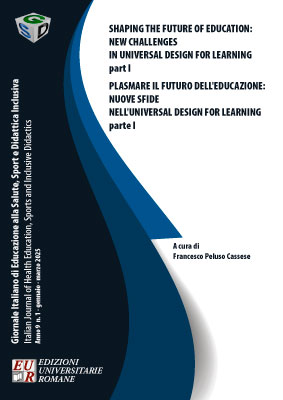
Dowloads
Pubblicato
Fascicolo
Sezione
Licenza
Copyright (c) 2025 Alessandra Lo Piccolo, Letizia Pistone, Daniela Pasqualetto

Questo volume è pubblicato con la licenza Creative Commons Attribuzione 4.0 Internazionale.
La licenza che si applica a questo articolo è quella indicata sopra e nella sua prima pagina. Dal Volume 7 (2023) la rivista pubblica con licenza Creative Commons Attribuzione 4.0 Internazionale (CC BY 4.0); gli articoli dei Volumi 1–6 (2017–2022) sono stati pubblicati con licenza Creative Commons Attribuzione – Non commerciale – Non opere derivate 3.0 Italia (CC BY-NC-ND 3.0 IT) e mantengono quella licenza. Gli autori mantengono i diritti sulla propria opera e concedono alla rivista il diritto di prima pubblicazione.
