
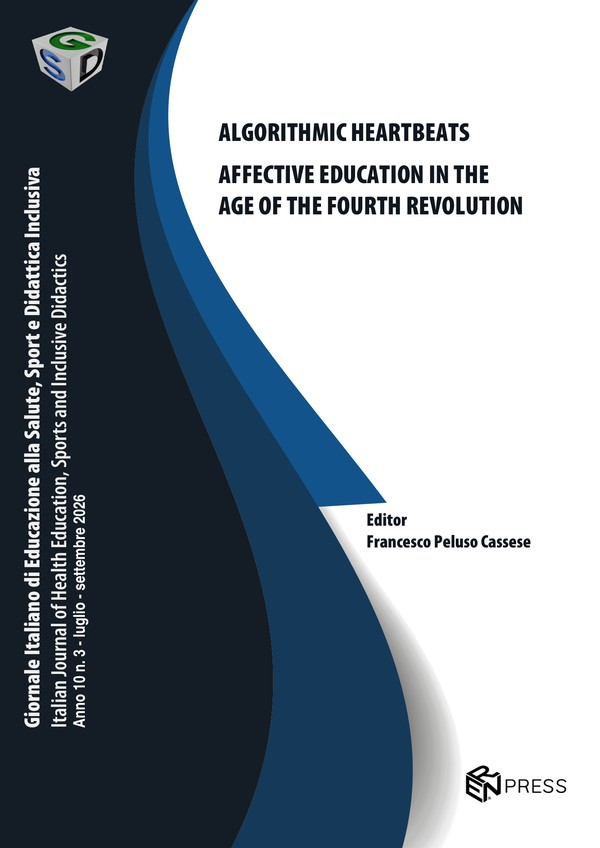
FROM TECHNOPHOBIA TO ETHICAL INTEGRATION: RESEARCH EVIDENCE ON TEACHER EDUCATION IN THE ERA OF AI
DOI:
https://doi.org/10.32043/gsd.v10i3.1776Parole chiave:
Critical AI Literacy, Digital Affective Literacy, Human-in-Command, Teacher professionalism, Mixed-method research.Abstract
This paper examines the challenges of AI-assisted education by integrating Critical AI Literacy (Veldhuis et al., 2025) with the Human-in-Command paradigm (AGID, 2024). Utilizing a mixed-methods research design involving 263 teachers, the study reveals a significant discrepancy between high conceptual familiarity with generative systems and a deficit in operational and ethical competencies. The evidence demonstrates that the fear of dehumanization reduces AI to mere automation, hindering authentic pedagogical integration. To overcome this professional impairment, we propose a Digital Affective Literacy model, essential for governing hybrid learning environments (Luckin, 2018). Transcending purely technical training, this work delineates the teacher as a pedagogical director of care, capable of orchestrating human-machine interaction while safeguarding relational responsibility and the depth of the human encounter (Andler, 2024; Ranieri et al., 2024).
Dowloads
Pubblicato
Fascicolo
Sezione
Licenza
Copyright (c) 2026 Iolanda Sara Iannotta, Deborah Gragnaniello

Questo volume è pubblicato con la licenza Creative Commons Attribuzione 4.0 Internazionale.
La licenza che si applica a questo articolo è quella indicata sopra e nella sua prima pagina. Dal Volume 7 (2023) la rivista pubblica con licenza Creative Commons Attribuzione 4.0 Internazionale (CC BY 4.0); gli articoli dei Volumi 1–6 (2017–2022) sono stati pubblicati con licenza Creative Commons Attribuzione – Non commerciale – Non opere derivate 3.0 Italia (CC BY-NC-ND 3.0 IT) e mantengono quella licenza. Gli autori mantengono i diritti sulla propria opera e concedono alla rivista il diritto di prima pubblicazione.
