
COGNITIVE AND NON-COGNITIVE SKILLS IN INCLUSIVE SCHOOLS: THE ROLE OF HYBRID LEARNING ENVIRONMENTS
DOI:
https://doi.org/10.32043/gsd.v10i3.1936Parole chiave:
Hybridlearning, skills, inclusion, education, learningAbstract
DUPLICATE PUBLICATION NOTICE – This article was published twice in error. The version of record is "Cognitive and non-cognitive skills in inclusive schools: the role of hybrid learning environments", Italian Journal of Health Education, Sport and Inclusive Didactics, Vol. 10 No. 3 (2026), https://doi.org/10.32043/gsd.v10i3.1744. Please cite that article. (Notice added by the Editors on 13 November 2026.)
AVVISO DI PUBBLICAZIONE DUPLICATA – Questo articolo è stato pubblicato due volte per errore. La versione di riferimento è "Cognitive and non-cognitive skills in inclusive schools: the role of hybrid learning environments", Italian Journal of Health Education, Sport and Inclusive Didactics, Vol. 10 No. 3 (2026), https://doi.org/10.32043/gsd.v10i3.1744. Si prega di citare quell’articolo. (Avviso aggiunto dalla Redazione il 13 novembre 2026.)
The growing complexity of contemporary educational contexts requires a rethinking of teaching practices from an inclusive perspective, integrating cognitive and non-cognitive dimensions to promote students’ overall well-being. In this framework, hybrid learning environments, combining physical and digital spaces, emerge as flexible ecosystems that support personalization, participation, and attention to diverse educational needs. This paper explores their role in fostering both cognitive and transversal skills, including emotional self-regulation, resilience, motivation, collaboration, and autonomy, which are essential for educational success and inclusion. Particular attention is devoted to the contribution of digital and multisensory technologies in enhancing inclusive learning processes. The study includes an experimental phase involving pre-service special education teachers (TFA support courses, primary and secondary levels), using a structured questionnaire to investigate perceptions, attitudes, and preparedness regarding integrated teaching practices. Findings reveal increasing openness toward innovation and hybrid environments, alongside challenges related to teacher training, technology management, and their effective pedagogical integration.Riferimenti bibliografici
Ainscow, M., & Booth, T. (2011). Index for Inclusion: Developing Learning and Participation in Schools. Bristol: CSIE.
Bandura, A. (1997). Self-Efficacy: The Exercise of Control. New York: Freeman.
Bonk, C. J., & Graham, C. R. (2012). The Handbook of Blended Learning. San Francisco: Pfeiffer.
Darling-Hammond, L., Hyler, M. E., & Gardner, M. (2020). Effective Teacher Professional Development. Palo Alto: Learning Policy Institute.
Díaz, V., & Brown, M. (2022). Hybrid learning ecosystems in higher education: Opportunities and challenges. Journal of Educational Technology & Society, 25(3), 45–60.
Dweck, C. S. (2006). Mindset: The New Psychology of Success. New York: Random House.
European Commission. (2023). Education and Training Monitor 2023. Brussels: European Commission.
Garrison, D. R., & Vaughan, N. D. (2008). Blended Learning in Higher Education. San Francisco: Jossey-Bass.
Heckman, J. J., & Kautz, T. (2012). Hard evidence on soft skills. Labour Economics, 19(4), 451–464.
Holmes, W., Bialik, M., & Fadel, C. (2023). Artificial Intelligence in Education: Promises and Implications for Teaching and Learning. Boston: Center for Curriculum Redesign.
Immordino-Yang, M. H., & Damasio, A. (2007). We feel, therefore we learn. Mind, Brain, and Education, 1(1), 3–10.
Mishra, P., & Koehler, M. J. (2006). Technological pedagogical content knowledge framework. Teachers College Record, 108(6), 1017–1054.
OECD. (2021). Beyond Academic Learning: First Results from the Survey of Social and Emotional Skills. Paris: OECD Publishing.
Siemens, G. (2023). Connectivism in the age of artificial intelligence. International Journal of Learning Technologies, 18(2), 1–15.
Tondeur, J., van Braak, J., Ertmer, P. A., & Ottenbreit-Leftwich, A. (2017). Teacher education and technology integration. Educational Technology Research and Development, 65(3), 555–575.
UNESCO. (2020). Global Education Monitoring Report 2020: Inclusion and Education – All Means All. Paris: UNESCO.
Zawacki-Richter, O., Marín, V. I., Bond, M., & Gouverneur, F. (2020). Systematic review of research on AI in education. International Journal of Educational Technology in Higher Education, 17(1), 1–25.
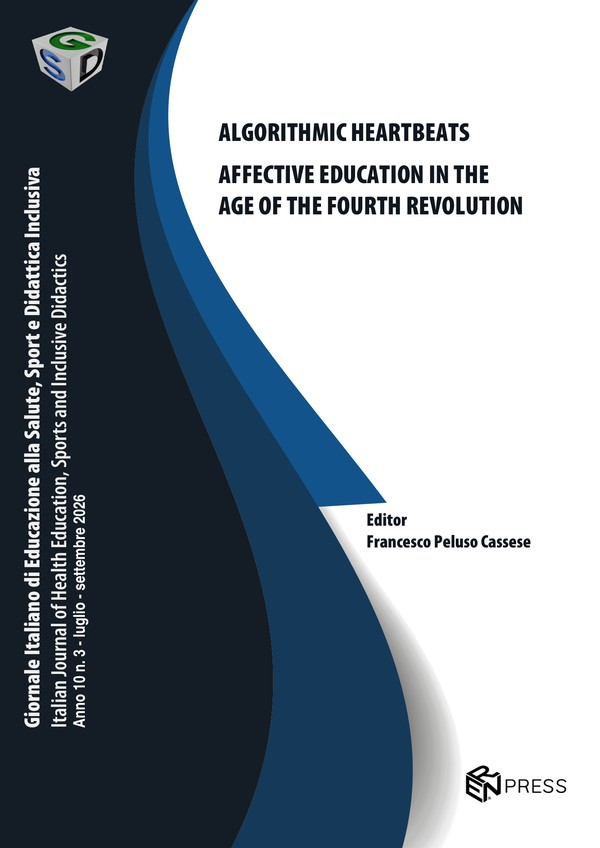
Pubblicato
Fascicolo
Sezione
Licenza
Copyright (c) 2026 Patrizia Belfiore, Giovanni Tafuri, Generoso Romano

Questo volume è pubblicato con la licenza Creative Commons Attribuzione 4.0 Internazionale.
La licenza che si applica a questo articolo è quella indicata sopra e nella sua prima pagina. Dal Volume 7 (2023) la rivista pubblica con licenza Creative Commons Attribuzione 4.0 Internazionale (CC BY 4.0); gli articoli dei Volumi 1–6 (2017–2022) sono stati pubblicati con licenza Creative Commons Attribuzione – Non commerciale – Non opere derivate 3.0 Italia (CC BY-NC-ND 3.0 IT) e mantengono quella licenza. Gli autori mantengono i diritti sulla propria opera e concedono alla rivista il diritto di prima pubblicazione.
