
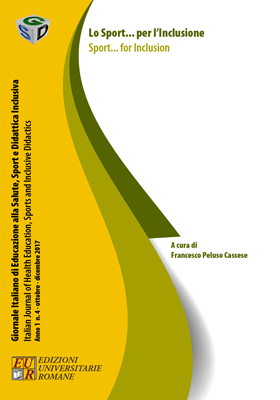
Sport & Inclusion
DOI:
https://doi.org/10.32043/gsd.v0i4.13Abstract
Over time, the changes in life and consumption styles of families, together with the access to sports practice of the weaker social groups such as old people, disabled, children, poor, etc., have given start to a real evolution of the meaning of sport that increasingly benefits the educational, inclusive and social value, downgrading the consideration of the competitive sports performance. In this perspective, starting with what a person is able to give or take, regardless of his physical or mental differences with others, sports encourages the consideration he has about himself and his existence, in full agreement with the assumption of inclusion.
The social and educational dimension of sports movement is now well-established and promoted internationally in support of integration and inclusion phenomena, and is matched with a reconsideration of the concept of health that leads to understand sport as a plurality of practices that help configuring it as an educational strategy in the way the subject should live his leisure time.
Downloads
Published
Issue
Section
License
Copyright (c) 2018 Goran Oreb

This work is licensed under a Creative Commons Attribution-NonCommercial-NoDerivatives 3.0 Unported License.
The licence that applies to this article is the one shown above and on its first page. Since Volume 7 (2023) the journal publishes under the Creative Commons Attribution 4.0 International License (CC BY 4.0); articles in Volumes 1–6 (2017–2022) were published under the Creative Commons Attribution–NonCommercial–NoDerivatives 3.0 Italy License (CC BY-NC-ND 3.0 IT) and keep that licence. Authors retain copyright of their work and grant the journal the right of first publication.
